
Get Ready to Explore
Engage your observations with reflections by the artist on selected works from their Gallery.
We are excited to bring you a new platform that will help you explore another dimension of some of the images in the Galleries. The comments are not necessarily what the painting is about, but more like an opportunity for you to overhear a conversation the artist has with his/her own work. The hope is that what you overhear in the conversations might get you thinking more about what you see or get from the painting ... maybe something outside the box.
Have a look below...
[Check back with us regularly. What's here is a work in process. Thanks.]
ABOUT WHAT FOLLOWS...
Three things to know about the comments:
1. they are what I had in mind before I started painting; or
2. they are what developed during the process of executing the work; or
3. they are what I learned from the painting once it was done.
What I offer does NOT explain the painting or its "meaning." Nor is it what you are supposed to think.
Commentary can be a portal or a curtain. It can open a door for discovery or it can blind you from seeing for yourself. As a viewer, you are the one who finishes the painting with your own insights.
.
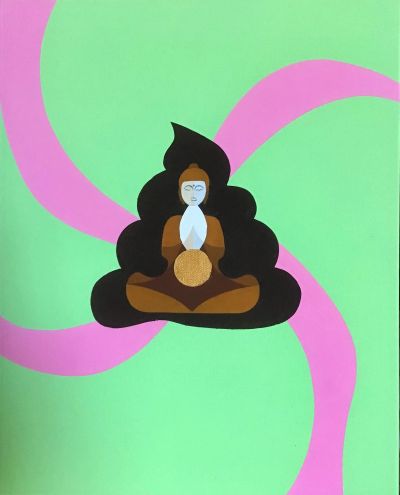
Sundae au Merde
The Buddha is in an emoji form that often is associated with a pile of dung. But it could also be a swirl of chocolate ice cream as well as something piled on the grass.
Ummon (862 - 949) is regarded as one of the most eloquent of Chan, Chinese Zen, masters. Also a most difficult one to understand. And yet his short teachings have become iconic and influential. For example, the composer, John Cage, incorporated nichinichi kore konichi (every day is a good day) in his Song Books for solo voice and Jack Kerouac used Ummon’s shit stick koan in The Dharma Bums. The koan went this way:
A monk asked Ummon, “What is Buddha?” and Ummon replied, “A dried shit stick.” (Case 21 in The Gateless Gate. See Paul Reps, Zen Flesh, Zen Bones) to which Mumon appended an interpretation, “Lightning flashes, Sparks shower. In one blink of your eyes you have missed seeing.” In Zen when we separate the sacred from the profane, the blessed from the cursed we have lost everything. God is one with creation, not a function of our preferences.
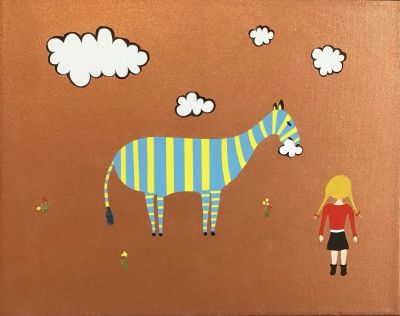
Dorothy and the Striped Zebronicus
This painting is not profound. It’s simple, childlike, whimsical, imaginative, and playful. Nothing to think about here nor to ask “why…?” about. It was just fun trying to do it with little thought given to anything but color, form, composition and kinship.
Dorothy was my mother’s name. She was from Kansas but that has no relevance here. Another Dorothy was also from Kansas and got swept up in a storm for which that region of the country is known. That too is mere coincidence. I am not from Kansas but I’ve stayed in a Holiday Inn Express there.
What does have relevance that probably shows is: It's hard to do a painting like this and make it look natural. It’s much easier to put a lot of thought into images I create. The temptation is always to mimic something real. But I try to ignore that seduction because if it suddenly looks real you've already seen it! All of the thought that's mine I don't expect of a viewer (although if it happened that'd be cool!) I just I keep painting as long as something comes to mind that I can’t really explain.
Plato's Shadow
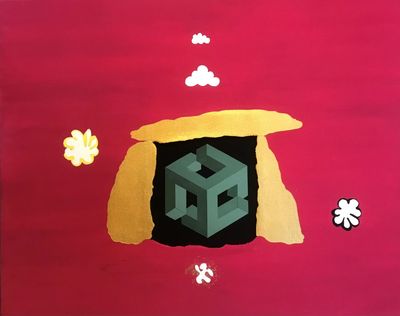
Plato’s shadows are forms cast on the wall of a cave. In The Republic he uses these shadows as an allegory of how easily we can be trapped in ignorance by our failure to recognize the difference between reality and appearances. We might call that trap one dimensional thinking or imagining that what we see, even three dimensionally, is the limit of our vision, the limit of what is real. So when we look at an impossible form, like the one in this painting, we’re inclined to see an illusion, a trompe l’oeil, that tricks us into thinking that what we see cannot be real, even though it exists mathematically.
A dolmen (loc.cit.) is a megalithic structure consisting of two or more upright stones supporting a large, flat capstone. Dating from the late neolithic period, four to three thousand years before the present, dolmen are sometimes called “portals” thought to be associated with burials. But who knows? Their structure is mysterious in both function and construction. If “portal” is an appropriate attribution, for whom? to where? and how? Who knows? And yet there they are, opening to enter or leave the mystery of Plato's cave.
(The impossible form in the center is set back 1/4 inch from the surface on a separately attached canvas.)
Nine of Hearts
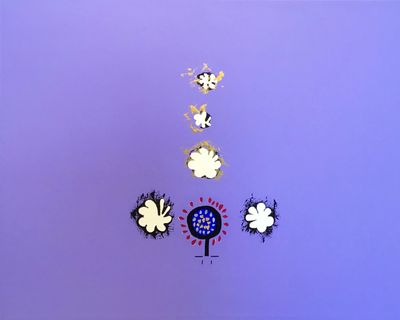
At the center of the tree form are nine hearts.
In cartomancy the nine of hearts is the card of joy, satisfaction, and fulfillment in life often associated with love and one’s relational connections both immediate and writ large. In numerology, a “Life Path 9” individual is considered compassionate, creative and disciplined, driven by high ideals with a thirst for knowledge and experience. They are known for their empathy, charisma, and spiritual depth but are challenged by their emotional sensitivity, self-sacrifice, and at times the need to let go.
This is pretty intriguing, but I was thinking of none of it doing this painting. So is it there? I know nothing about either cartomancy or numerology or for that matter any of the esoteric arts. The only thing esoteric here is the artwork. To be both frank and accurate, I learn from my painting. I have often said that for me, art is part of my spiritual practice. There is no hidden meaning that a viewer is supposed to puzzle out and “get.” Above all things, this painting is an illustration of nothing other than what it is in the eye of the beholder.
The Zepplin Series
This series features a rigid airship (not a blimp) based on the magnificent Graf Zeppelin, that behemoth of the skies that transformed the dream of trans-Atlantic flight into a luxurious travel experience.
However the paintings do not celebrate a golden era of aviation history. These airships are a visual metaphor to capture the machinations of our thinking. In its day the Zeppelin meant different things to different people. Pacifists believed that airships eventually would effect a new sense of interdependence and produce world unity. Militarists hoped the airship would become the ultimate weapon. Technocrats saw only the money in it. Meanwhile the technicians anticipated the transfiguration of life.
That split between the technological sublime and the betrayal we experience when technology fails or turns instead into disaster is emblematic of the apprehensions we have, or should have, whenever we misplace our faith with an unselfcritical consciousness and hubris turns what we imagine is salvation into dissolution.
